
Trithrinax campestris
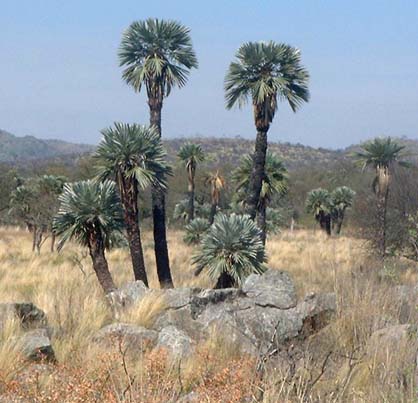
Family: Arecaceae Palm Tree
Common Name: Campestre palm
Scientific Synonymy:
Copernicia campestris, Chamaethrinax hookeriana
Common Synonymy:
Blue needle palm, Caranday palm. German: Blaue Nadelpalme. Spanish: Caranday, Palmera de Argentina, Palmera del Uruguaya.
Cold Hardiness Zone: 8a View the UK and US zone maps
Trithrinax campestris Information
A clump-forming, medium sized, drought tolerant, slow growing, monoecious palm. Common in cultivation, and common in the wild. It has fibrous, light-grey trunks, 6 m. (20 ft.) tall, 20.3 cm. (8 inch) diameter with no obvious leaf scars, and large partially segmented, palmate (fan) leaves, 0.6 m. (2 ft.) long, 0.6 m. (2 ft.) wide, bluish-sliver above and greyish green beneath.
Trithrinax campestris can tolerate freezing temperatures to about -12°C (10.4°F). It naturally occurs in open, sun exposed, montane or lowland hilly locations, and should be planted to maximise sunshine exposure. Under extreme freezing conditions we recommend you keep this palm as dry as possible, which will usually mean constructing a glass or plastic roof over the plant to keep rain off. Any cover placed over this palm during times of rain or during cold nights must be removed or vented during hours of sunshine or the plant could be severely heat exhausted.
Species information currently being revised.
Distribution
Native to: Argentina, Uruguay